
01How to choose a base in Cambodia
Cambodia is small on the map and slow on the road. A 300 km (186 mi) trip between two towns can eat most of a day, so the base you choose decides what you actually see.
Two rules cover most trips. First, match the base to the reason you came, temples, city, coast or quiet. Second, count the transfer time, not the distance. Domestic flights link Phnom Penh and Siem Reap in under an hour; the same route by bus takes five to seven hours depending on stops.
Most travelers split a two-week trip into two or three bases rather than hopping every night. That rhythm also gets you better rooms: longer stays often unlock lower nightly rates.
One more thing shapes your choice, the season. More on that below, because it changes both the price and the roads.
02Siem Reap: the temple base
Siem Reap exists because of Angkor, and almost every hotel here is built around getting you there early. The town sits a few kilometers from the Angkor Archaeological Park entrance, so a tuk-tuk ride to the ticket gate takes about 15-20 minutes.
Where you sleep inside Siem Reap changes your mornings. Three zones matter:
- Old Market and Pub Street, walkable, loud at night, best if you want restaurants and bars on foot.
- Wat Bo Road and the river east bank, quieter, still a short walk from the center, good mid-range pick.
- Outside the center toward Angkor, resort-style properties with pools and gardens, but you need a ride for dinner.
Sunrise at Angkor means leaving before dawn. If your hotel is on a quiet road, you sleep better the night before, and that is worth more than a rooftop bar.
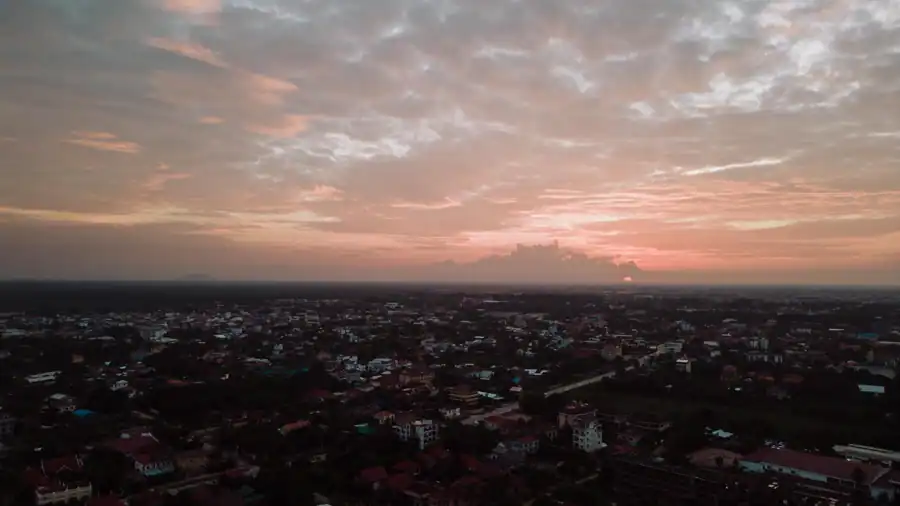
Three hotel zones in Siem Reap, and how far each sits from the Angkor entrance road.
03Phnom Penh: business, history, food
Phnom Penh is Cambodia's capital and its most expensive hotel market, not because rooms cost more, but because the good ones cluster in a few streets.
The riverside along Sisowath Quay puts you near the Royal Palace, the night market and the ferry piers. It is the obvious first-timer choice. South of there, around BKK1, you get quieter streets, cafés and longer-stay apartments that suit a week rather than a night.
Two sights shape most itineraries: the Royal Palace and the Tuol Sleng Genocide Museum. Both are heavy, and both are better with a calm hotel to return to. Pick a room with real air conditioning and a desk, the city is hot and you will want an hour off in the afternoon.
Traffic is the hidden cost here. A hotel two kilometers from the river can take 25 minutes in the evening, so check the map before you book on price alone.
04Kampot and Kep: the slow south
Kampot and Kep are where Cambodia stops rushing. Both sit on the southern coast, roughly 150 km (93 mi) from Phnom Penh, and both trade temple crowds for pepper farms, riverside sunsets and empty roads.
Kampot is a river town with old shophouses and a growing set of small guesthouses. Kep is a former colonial resort town, quieter still, known for crab at the market and a national park on the hill behind it.
Rooms here are simple. Expect fans, cold water in the cheapest places, and a pool only at the mid-range and up. What you get instead is space and quiet, and a base for day trips to the pepper plantations and the Bokor hill road.
If you want a beach, this is not it. The coast here is for sunsets, not swimming.
05Koh Rong and Koh Rong Sanloem
The islands off Sihanoukville are the beach answer, and they split into two moods. Koh Rong is the bigger, busier one, with a party strip and a spread of bungalows along Long Set and Sok San beaches. Koh Rong Sanloem, its neighbor, is smaller and calmer, with a handful of bays that stay quiet even in high season.
Book early for the December-March window. That is peak season on the islands, and the good beachfront bungalows sell out weeks ahead.
Power and water are the practical limits. Some island stays run generators for part of the day and rely on tanked water, so ask before you book if air conditioning and 24-hour electricity matter to you. Ferries from Sihanoukville take roughly 45 minutes to an hour, and the last boats leave in the afternoon.
One warning: Sihanoukville itself has changed fast and is no longer the relaxed beach town in older guidebooks. Most travelers now pass straight through to the piers.
06Battambang and the quiet northwest
Battambang is Cambodia's second city and the opposite of Siem Reap. It has colonial shophouses, a bamboo train, and countryside you can reach by bicycle in ten minutes.
Hotels here are small and cheap, often family-run. It suits travelers who have already seen Angkor and want a few unhurried days. The trade-off is transport: reaching Battambang from Siem Reap takes a few hours by road, and the route is not always fast.
Prices in Cambodia swing hard by season and by town, so treat any single figure as a range. The table below shows typical nightly bands in US dollars, Cambodia uses dollars alongside the riel for most tourist payments.

| Area | Main draw | Budget room | Mid-range | Best months |
|---|---|---|---|---|
| Siem Reap | Angkor temples | $10-25 | $30-80 | Nov-Mar |
| Phnom Penh | City, history, food | $15-30 | $40-100 | Nov-Feb |
| Kampot | River, pepper farms | $8-20 | $25-60 | Nov-Mar |
| Kep | Crab, quiet coast | $10-25 | $30-70 | Nov-Mar |
| Koh Rong | Beaches, nightlife | $15-35 | $40-120 | Dec-Mar |
| Koh Rong Sanloem | Quiet beaches | $15-35 | $40-110 | Dec-Mar |
| Battambang | Colonial town, countryside | $8-20 | $20-50 | Nov-Feb |
Rates climb sharply around Christmas, New Year and Khmer New Year in mid-April, when domestic travel peaks and coastal rooms fill first.
07Booking mistakes and what they cost you
Most bad hotel experiences in Cambodia come from three avoidable choices.
- Booking on price alone in Phnom Penh. A cheap room far from the river can add an hour of traffic a day, you pay it back in tuk-tuks.
- Assuming every island bungalow has 24-hour power. Many do not. You find out at 2 a.m. when the fan stops.
- Leaving island ferries to the last afternoon. Boats stop running before dark, and a missed crossing means an unplanned night in Sihanoukville.
- Ignoring the rainy season. From roughly May to October, unpaved roads and island crossings get slower, and some beach bungalows close entirely.
None of these are disasters. All of them cost a day or a night you would rather spend elsewhere.
08Questions travelers ask
Which area is best for a first trip to Cambodia?
Siem Reap plus one other base. Siem Reap covers Angkor, and Phnom Penh or the southern coast gives you a second, different Cambodia. Two bases in ten days is comfortable; three is possible if you fly between them.
Are Cambodia hotels cheap?
Yes, relative to Europe or North America. Clean budget rooms with a fan and private bathroom start around $10-15 a night in most towns, while a pool and air conditioning usually lands in the $30-80 band. Island and capital prices run higher.
When should I book?
For the December-March high season, book coastal and island rooms several weeks ahead, longer for the Christmas and New Year weeks. In the low season you can often decide a day or two in advance.
Do hotels accept US dollars?
Most do, and prices for tourists are usually quoted in dollars. Small change often comes back in riel, so keep a few small notes for tuk-tuks and markets.
09Pick the base, then the room
In Cambodia the area decides your trip and the room only decides your sleep. Choose Siem Reap for temples, Phnom Penh for the city, Kampot or Kep for quiet, and the islands for sand, then match the season to the place. Get those two right and almost any well-reviewed hotel will do the rest.
10More on the site
Read next
Canada hotels: how to choose and what to avoid
A $39 "resort fee" appears on your bill in Banff. You never saw it when you booked. That single line is why Canada trips go over budget. The country…

Brazil hotels: how to choose and what to avoid
Brazil won 2-1. That scoreline from June 29, 2026 tells you almost nothing about how the night felt. If you searched for japan vs brazil live…
Where to stay in Australia: areas and hotels worth booking
Australia is roughly the size of the continental United States, so "where to stay" really means "which city, and which pocket of that city." Sydney…