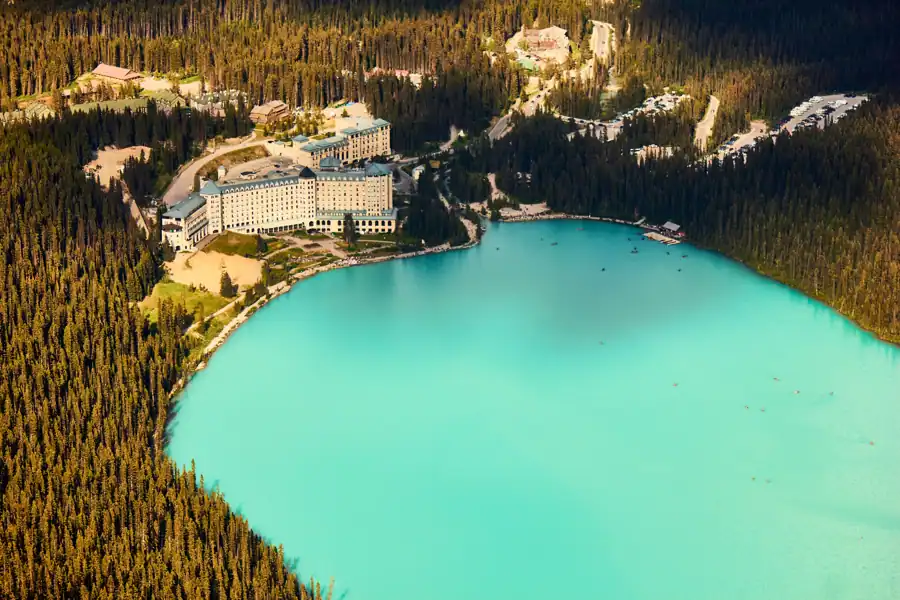
That single line is why Canada trips go over budget. The country is enormous, a drive from Toronto to Vancouver covers roughly 4,400 km (2,700 miles), wider than most of Europe, and the hotel you pick in one province looks nothing like the one in the next. A downtown tower in Montreal, a roadside motel in Saskatchewan and a ski lodge in Whistler follow different rules, different tax structures and different seasons. Choose wrong and you pay city prices for a highway room, or book a "lakeside" property that sits 20 minutes from the water.
Here is how to sort the good from the overpriced, and which traps to check before you confirm.
01What actually drives the price in Canada
Location and season decide the rate. Brand matters far less than most travelers assume.
A mid-range room in downtown Toronto or Vancouver can run two to three times the price of a comparable room 30 minutes outside the core. The same chain logo sits on both. What you are paying for is walking distance, transit access and the view, not the mattress.
Three factors move the number most:
- City core vs. suburbs. Downtown rates spike on weekdays for business travel, then drop on weekends.
- Season. Ski towns and national parks invert the usual pattern, winter and summer are peak, spring and fall are cheap.
- Event calendar. A single convention, concert or hockey playoff game can double every room in a city for two nights.
The third factor is the one that catches people out, and it is invisible on the hotel's own page. More on that below.
 объясняет
02Where to stay: downtown, airport or highway
Pick the zone first, the property second. Most disappointment comes from choosing a nice hotel in the wrong location.
Canada's cities are car-dependent outside a handful of downtowns. Toronto, Montreal and Vancouver have usable subway or metro systems. Almost everywhere else, you need a vehicle or a shuttle, and that changes the math completely.
| Zone | Best for | Typical trade-off | Parking |
|---|---|---|---|
| Downtown core | Walkable sightseeing, no car | Highest rate, smallest rooms | $25-50 per night |
| Airport area | Early flights, one-night stops | Nothing nearby to walk to | Often free |
| Suburbs | Families with a car | 30-40 min to attractions | Usually free |
| Highway motel | Road trips, budget | Thin walls, dated rooms | Free, outside the door |
Airport properties are the quiet winners for short stays. A place like Home2 Suites by Hilton Atlanta Airport West shows the pattern, free shuttle, free parking, kitchenette, and Canadian airport hotels follow the same playbook. You trade atmosphere for convenience and save real money.
If you want a city base with character instead of a chain box, small independent properties often beat the big names on location. The LX Hotel, a Travelodge by Wyndham is a good example of how a modest brand can still deliver a central position, worth remembering when you compare Canadian listings.
03Red flags to check before you book
Read the last 20 reviews, not the first 20. Recent complaints repeat; old praise does not.
Sort reviews by newest and scan for patterns. One bad night is noise. The same sentence three times is a fact.
- "Under renovation." Construction noise from 8 a.m., closed pool, scaffolding over the window. Call and ask for dates.
- Resort fees. Common in Banff, Whistler and lake resorts. They cover "amenities" you may never use and are added at checkout.
- Deposit holds. Many Canadian hotels place a hold of $100-300 on your card at check-in, released days later.
- No air conditioning. Real in older properties and in coastal BC, where summers are mild, until they are not.
- Photo framing. A "mountain view" can mean a sliver between two buildings. Check the map, not the gallery.
One more: confirm the cancellation window in writing. "Free cancellation" often expires 48 or 72 hours before arrival, and ski-season bookings can demand two weeks.
Ask for the full folio at check-in, not at checkout, fees are easier to dispute early.
04Taxes, fees and the real total
The advertised rate is never the price you pay. Budget 15-20% above it.
Canada adds a federal goods and services tax on top of provincial tax, and some cities charge an additional accommodation levy. The combined rate varies by province, so a $200 room in one city and a $200 room in another can differ by $20 or more at checkout.
Then come the extras: parking, breakfast, resort fees, pet fees. A property that includes all four can beat a cheaper listing that charges for each. When you compare two options, compare the checkout total, not the headline number.
This is also where booking direct pays off. Third-party prepaid rates are usually non-refundable, and if your flight slips, the hotel cannot help you, the reservation belongs to the agency. For anything weather-dependent, book flexible.
05Season timing that changes everything
Canada has two travel seasons, and they do not match the calendar you expect.
Summer (late June to early September) is peak almost everywhere, with the highest rates in national parks and coastal BC. Winter splits the country: ski resorts in Alberta and BC hit their maximum from December to March, while most other cities drop to their lowest rates of the year.
The sweet spots are the shoulder weeks, late September to mid-October, and April to May. Rates fall, crowds thin, and most attractions stay open. In ski country, the cheapest window is usually right after the mountain closes and before hiking season starts.
The exception is event-driven pricing. If your dates land on a major festival or a playoff run, no shoulder logic applies. Check the city's event calendar before you commit, then book early or shift by a week.
Small properties reward the same discipline. A quiet apartment-style stay, like A PERFECT STAY- 2 James Cook Apartments, tends to hold its value better than a big hotel in high season, and the same is true of Canadian equivalents.
06Frequently asked questions
Are Canada hotels expensive compared with the US?
Often cheaper once you account for the exchange rate, especially outside the three biggest cities. Downtown Toronto and Vancouver are the exceptions and rival major US metros.
Do I need to tip at a Canadian hotel?
Not required, but housekeeping and bell staff usually receive a few dollars. It is not built into the bill the way it is in some countries.
Is parking really that expensive?
In downtown cores, yes, nightly rates of $25-50 are normal, and some charge by the hour. Suburban and airport properties usually include it free.
What is a resort fee in Canada?
A mandatory daily charge added at checkout for amenities such as Wi-Fi, gym or shuttle. It is most common at mountain and lakeside resorts and must be disclosed before you book.
When is the cheapest time to book a Canadian hotel?
Shoulder seasons, late September to mid-October and April to May, offer the lowest rates outside ski country. Booking two to three months ahead helps in national parks, where supply is limited.
Get the zone right, read the newest reviews, and add 20% to every price you see. That covers most of what goes wrong.
07More on the site
Read next
Where to stay in Cambodia: areas and hotels worth booking
Book Siem Reap for temples, Phnom Penh for cities, Kampot or Kep for slow days, and the southern islands for sand. Cambodia hotels are cheap by…

Brazil hotels: how to choose and what to avoid
Brazil won 2-1. That scoreline from June 29, 2026 tells you almost nothing about how the night felt. If you searched for japan vs brazil live…
Where to stay in Australia: areas and hotels worth booking
Australia is roughly the size of the continental United States, so "where to stay" really means "which city, and which pocket of that city." Sydney…